"United 2026": A Look at the Expanded FIFA World Cup Across Three Countries
The 2026 FIFA World Cup breaks tradition, expanding to 48 teams hosted across the United States, Canada, and Mexico.
FIFA World Cup 2026 Explained: A Three-Nation Tournament
The FIFA World Cup 2026 will be the first edition of the global football tournament to be hosted across three nations—the United States, Canada, and Mexico—and will feature an expanded format with 48 teams competing for the trophy.
Why is it in the news?
The upcoming FIFA World Cup in 2026 marks a historic shift in the tournament's structure and scale. For the first time, three countries will share hosting duties, and the number of participating teams will increase significantly. This expansion and multi-national hosting model have generated interest and discussion among football fans, host cities, and sports analysts regarding the logistical complexities and potential impacts on the competition. FIFA officials, including President Gianni Infantino, have emphasized the record-breaking nature of this tournament, noting it will "feature more countries, more teams, and more matches" than any previous edition, as stated on the official FIFA website.
What is the background of this change?
The decision to expand the FIFA World Cup to 48 teams was made by the FIFA Council in January 2017. Prior to this, the tournament had maintained a 32-team format since the 1998 World Cup in France. The expansion aims to offer more opportunities for national teams worldwide to participate in the prestigious event.
In June 2018, the joint bid from the United States, Canada, and Mexico, known as "United 2026," was selected to host the tournament, beating out a rival bid from Morocco. This marks Mexico's third time hosting (after 1970 and 1986) and the United States' second (after 1994), while Canada will host for the first time. The confederation CONCACAF (the Confederation of North, Central America and Caribbean Association Football) will host the tournament for the first time since 1994.
How will it work?
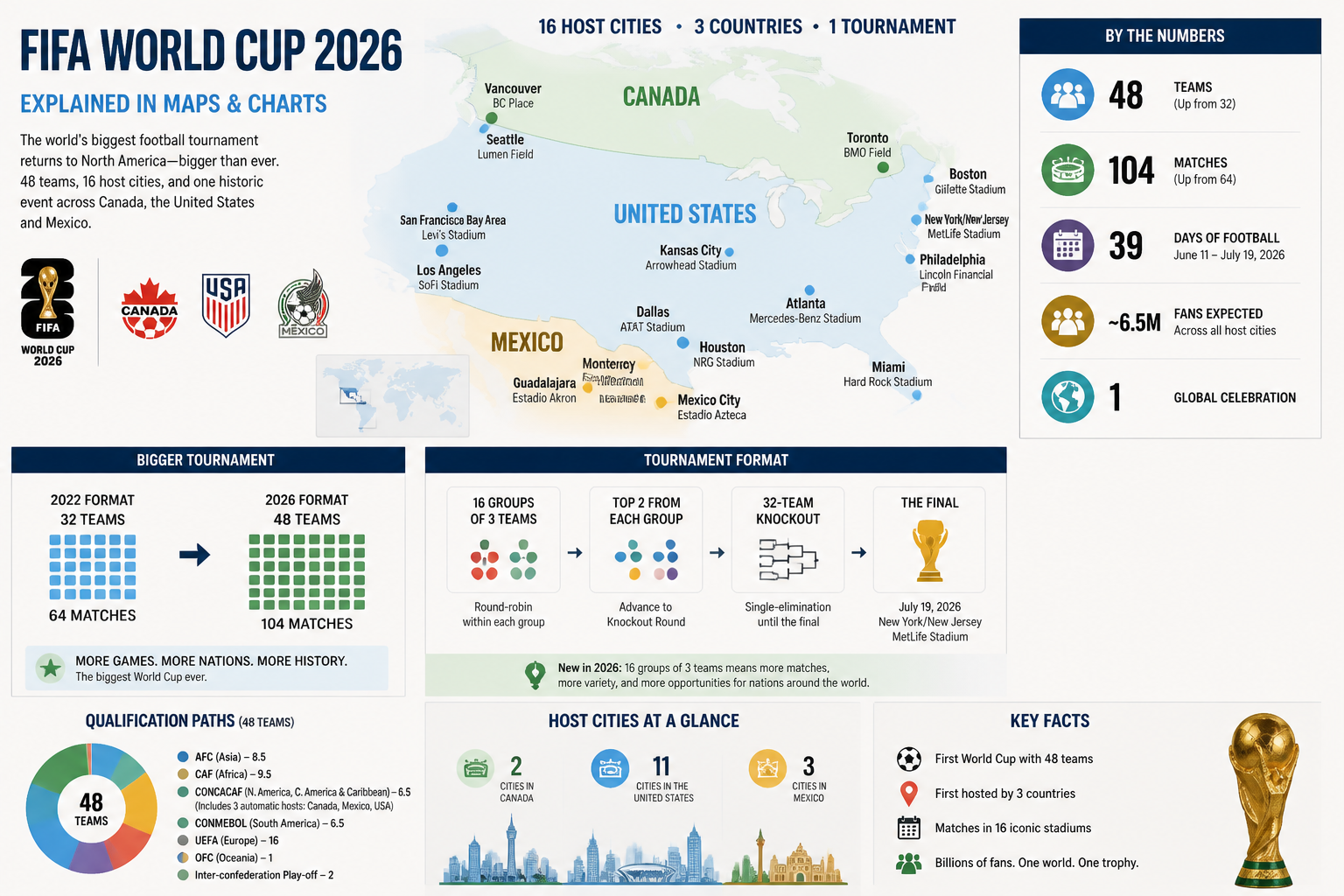
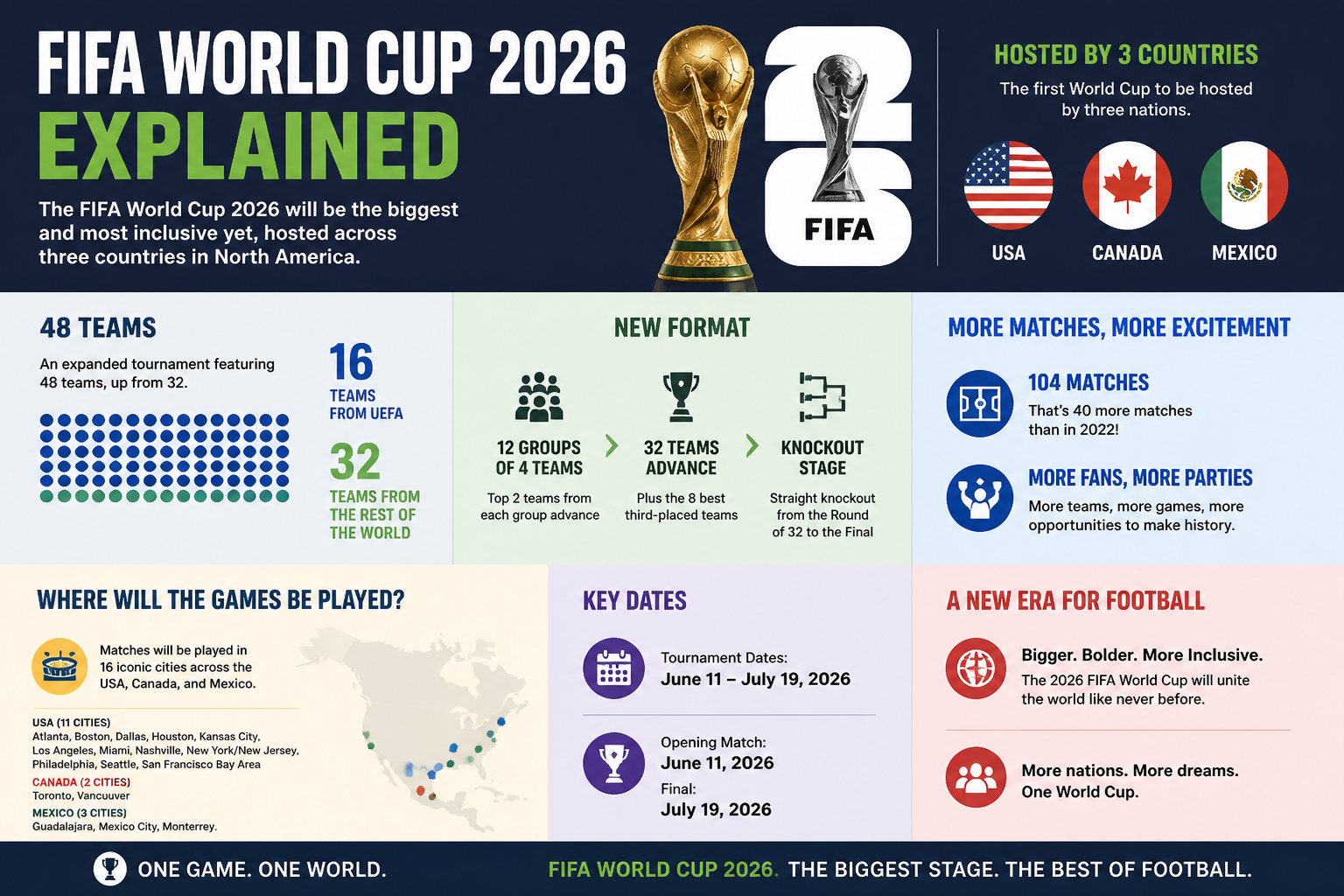
The FIFA World Cup 2026 will expand from 32 to 48 teams, leading to a significant increase in the number of matches played. The tournament will feature 104 matches, a substantial rise from the 64 played in the 2022 World Cup.
Host Countries and Cities:
- United States: The U.S. Will host 60 matches, including all quarter-finals, semi-finals, and the final. Cities include Atlanta (Mercedes-Benz Stadium), Boston (Gillette Stadium), Dallas (AT&T Stadium), Houston (NRG Stadium), Kansas City (Arrowhead Stadium), Los Angeles (SoFi Stadium), Miami (Hard Rock Stadium), New York/New Jersey (MetLife Stadium), Philadelphia (Lincoln Financial Field), San Francisco Bay Area (Levi's Stadium), and Seattle (Lumen Field).
- Canada: Canada will host 10 matches, spread across two cities: Toronto (BMO Field) and Vancouver (BC Place).
- Mexico: Mexico will also host 10 matches in three cities: Guadalajara (Estadio Akron), Mexico City (Estadio Azteca), and Monterrey (Estadio BBVA).
Tournament Structure: The 48 teams will be divided into 12 groups of four teams each. This differs from the previous format of eight groups of four.
- Group Stage: Each team will play the other three teams in their group once. The top two teams from each of the 12 groups will advance to the knockout stage, along with the eight best third-placed teams. This means 32 teams will progress from the group stage, maintaining a similar round of 32 for the knockout phase as in previous 32-team tournaments.
- Knockout Rounds: The tournament will proceed with a Round of 32, followed by the Round of 16, quarter-finals, semi-finals, a third-place play-off, and the final. This extended knockout phase will further intensify the competition.
The increased number of teams means more qualification spots for each of FIFA's six confederations. For instance, UEFA (Europe) will see its allocation rise from 13 to 16 teams, while CAF (Africa) will increase from 5 to 9.5 (meaning one team enters an intercontinental play-off).
Who is affected?
The expansion and multi-nation hosting will affect a wide range of stakeholders:
- Teams and Players: More national teams will have the opportunity to participate, potentially boosting football development in regions less represented in past tournaments. Players will face increased travel demands across vast distances, particularly when traversing the three host countries. Teams will need robust logistical support to manage their training camps and travel schedules efficiently.
- Fans: Supporters will have more matches to attend, but also face the challenge of navigating potentially long distances between venues, requiring careful planning for accommodation and transportation across different cities and even countries. Entry requirements and currency exchanges between the three nations will also be a consideration for international visitors.
- Host Cities and Local Economies: The 16 host cities anticipate significant economic benefits from tourism, job creation, and infrastructure development. However, they also face the substantial costs and logistical challenges of hosting multiple high-profile events, including managing crowds, security, and transportation.
- Broadcasters and Sponsors: The expanded format and increased number of matches offer more broadcast content and advertising opportunities, potentially leading to higher revenue streams for FIFA and its partners.
What to watch next?
As 2026 approaches, several key areas will be under close scrutiny:
- Match Schedule and Logistics: FIFA is expected to release a detailed match schedule, including specific venue assignments for group stage matches and knockout rounds. The allocation of matches and the flow of teams between the three host nations will be crucial in managing travel for teams and fans.
- Infrastructure Preparedness: The host cities, particularly those undergoing stadium renovations or significant infrastructure upgrades, will need to demonstrate their readiness. This includes public transportation, accommodation, and security measures. In January 2024, FIFA announced the match schedule format, confirming the final will be held in MetLife Stadium in New Jersey, with the opening match at Mexico City's Estadio Azteca.
- Qualification Process: The various confederations will finalize and implement their qualification tournaments, determining which nations will claim the expanded number of spots in the World Cup. These qualification rounds will provide an early look at new contenders emerging due to the increased participation opportunities.
- Fan Experience Initiatives: Organizers will likely introduce tools and initiatives to help fans navigate the large geographical area of the tournament, such as integrated travel passes or digital guides for cities and matches.