48 Teams, Three Hosts: Understanding the FIFA World Cup 2026
The 2026 FIFA World Cup introduces a significantly larger format with 48 teams and three host nations.
FIFA World Cup 2026 Explained
The FIFA World Cup 2026 is the next iteration of the quadrennial international men's football championship, organized by FIFA, and will be notably the largest in the tournament's history, expanding to 48 teams across three host nations.
Why is it making news now?
The tournament, scheduled from June 11 to July 19, 2026, is drawing increasing attention as the qualifying process for most teams is underway. With the automatic qualification of the three host nations – the United States, Canada, and Mexico – the focus is now on how the remaining 45 spots will be filled through a two-year qualification campaign spanning FIFA's six continental confederations. This expansion and multi-nation hosting arrangement represent significant departures from previous World Cups.
Background
The journey to the 2026 tournament has involved several key decisions and format changes.
2017: FIFA officially announced in January 2017 that the World Cup would expand from 32 to 48 teams, beginning with the 2026 edition. This marked the first expansion since the 1998 tournament in France, which increased from 24 to 32 teams.
2018: The joint bid from the United States, Canada, and Mexico, branded as the "United 2026" bid, was selected as the host for the 2026 FIFA World Cup on June 13, 2018, during the 68th FIFA Congress in Moscow, Russia. They beat out a competing bid from Morocco. This marked the first time the World Cup would be hosted by three nations.
2022: FIFA confirmed the 48-team format would include 12 groups of four teams, followed by a new round of 32, which was a change from an earlier proposal of 16 groups of three teams.
How it works
The FIFA World Cup 2026 introduces a new structure due to its expanded size.
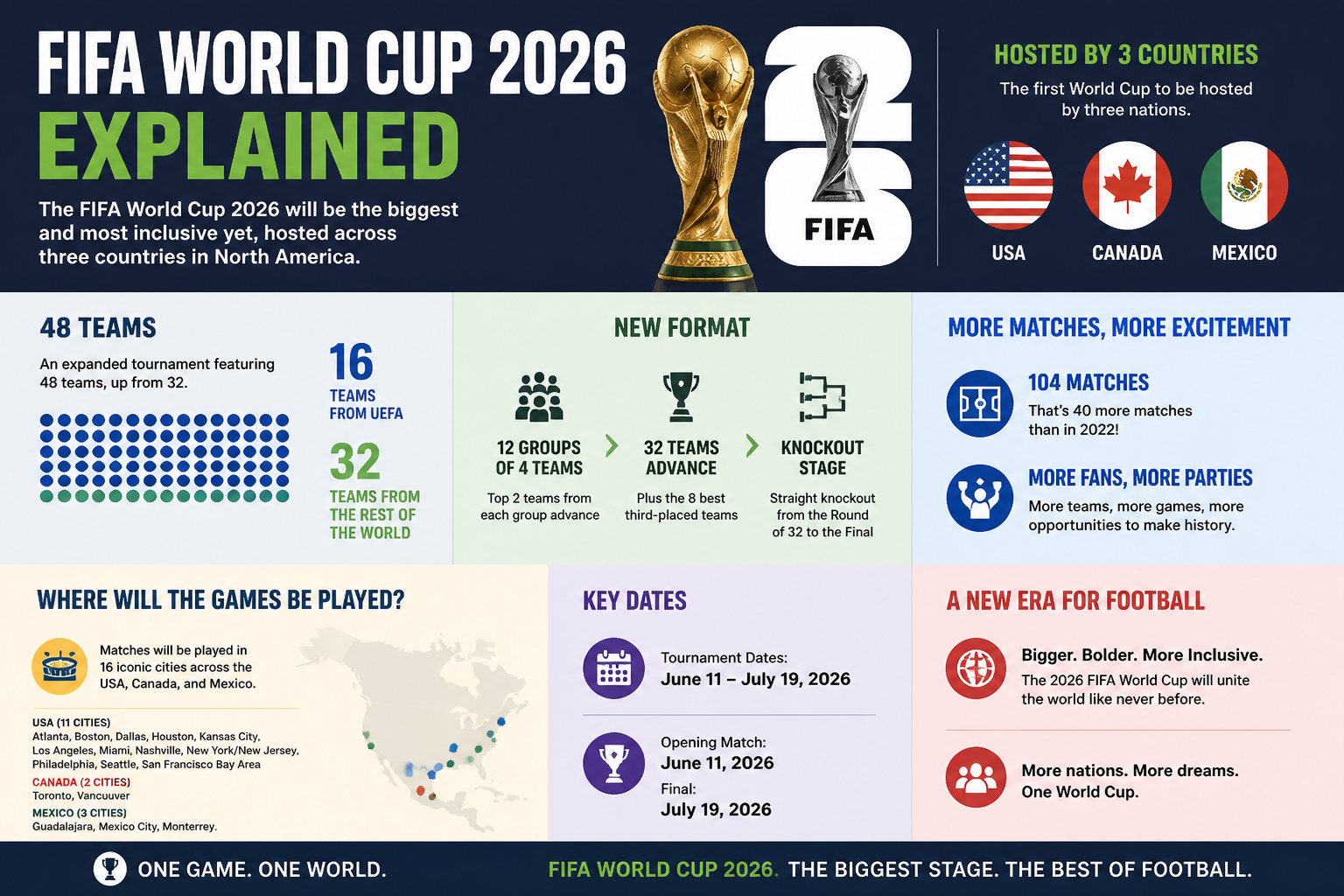
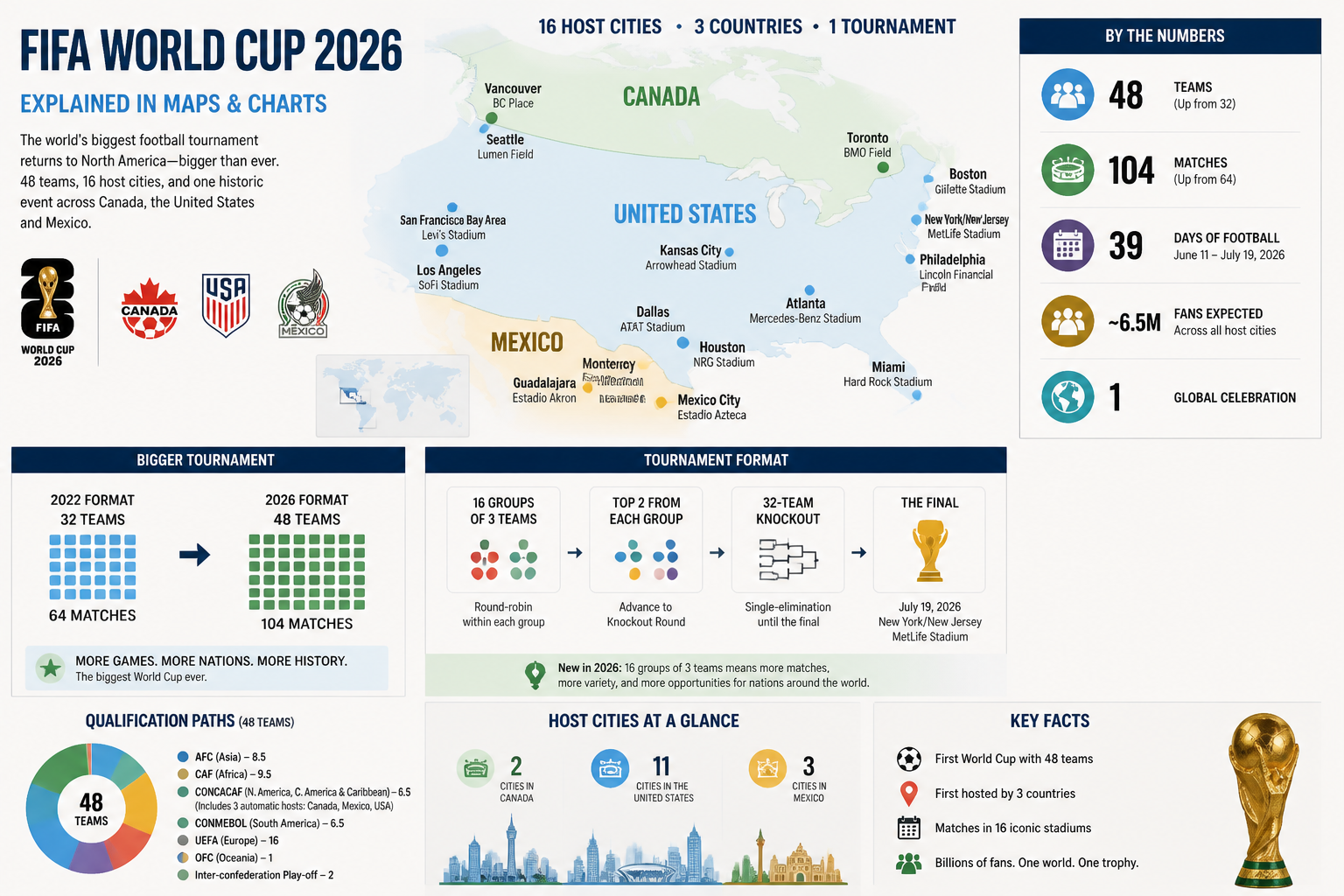
The tournament will feature 48 national teams, a significant increase from the 32-team format used since 1998. The three host nations—the United States, Canada, and Mexico—automatically qualify for the tournament. The remaining 45 spots are determined through qualification matches organized by FIFA's six confederations (AFC, CAF, CONCACAF, CONMEBOL, OFC, and UEFA). These qualification tournaments typically run for two years leading up to the World Cup.
The competition begins with a group stage comprising 12 groups, each with four teams. In this phase, teams within each group will play each other once. The top two teams from each of the 12 groups, alongside the eight best third-placed teams, will advance to the knockout stages. This means that 32 teams will progress from the group stage, rather than the 16 under the previous format.
Following the group stage, the tournament will move into a round of 32, a new addition necessitated by the larger field. From there, it will proceed to a round of 16, quarter-finals, semi-finals, and finally the World Cup Final on July 19, 2026. The knockout rounds will consist of single-elimination matches. The tournament will be held across 16 host cities: 11 in the United States, 3 in Mexico, and 2 in Canada.
Who's affected
The expansion and multi-nation hosting of the FIFA World Cup 2026 will have wide-ranging effects.
Host Cities: The 16 designated host cities stand to benefit from significant economic activity. This includes revenue from tourism, hospitality, infrastructure development, and increased employment opportunities. However, they also face challenges related to managing large crowds, security, and potential traffic congestion. For example, cities in the United States such as New York/New Jersey will need to accommodate thousands of visitors and implement extensive logistical planning.
National Teams: For national teams, the expanded format offers more opportunities to qualify, especially for nations that previously found it difficult to secure a spot in the 32-team tournament. This could lead to a more diverse representation of countries on the global stage. However, it also means a longer, more demanding tournament for teams that advance deep into the competition.
Fans: Supporters will have more matches to watch, distributed across a wider geographical area. This presents opportunities for fans to travel within North America to follow their teams, but also potential challenges regarding travel logistics, accommodation costs, and visa requirements for international visitors.
Local Economies: Beyond the host cities, the event will likely boost economies across the wider regions of the United States, Canada, and Mexico through increased tourism, retail sales, and media rights. Small businesses, service providers, and transportation networks are all expected to experience increased demand.
What to watch next
As the FIFA World Cup 2026 kicks off (literally), several key developments are anticipated.
FIFA will be announcing further details regarding the match schedule, including specific stadium assignments for group stage and knockout matches. This will be crucial for fans planning to attend.
Information on ticketing packages and sales windows will be released, often in phases, with priority given to certain groups before general public sales.
The conclusion of the qualification campaigns across all confederations will finalize the list of 45 participating nations, setting the stage for the official tournament draw. This draw will determine the group stage matchups, typically a highly anticipated event that generates significant discussion among fans.
Challenges may include coordinating logistics across three countries with different regulations and border controls, managing the environmental impact of increased travel, and ensuring adequate infrastructure and security measures are in place for all 16 host cities.